Categories
Uncategorized

Pinterest will be My Downfall….

This is one of those weeks where I didn’t get a lot of work done on my own things, but did get a lot of work completed for my little quilting world.  I’ve been so terribly busy with organizing my guild’s quilt and vendor show that I’ve had little time to devote to my quilting or piecing.  I’m thankful to say that most of the work is now complete.  I have to finalize the vendor layout, make the welcome packets, and print the quilt tags.  After that, it’s pretty much just wait until quilt take in day.


Whew.


While I don’t mind working for my guild, I can honestly say I will be happy when the show is over and I have this off my shoulders.  This is the first time my guild has done a two-day show as well as a judged show, so the logistics on this one has been a little different and I’ve been scared to death that I’m going to forget something.  By nature I’m a list maker, so I have about half a dozen lists and then a list of my lists so I don’t forget anything.


However, the time and my circumstances have limited my sewing time.  I hope I can make up for the lost progress this weekend.  The next two days are ripe for some sewing progress.


I have come across a couple of really neat patterns and ideas this week that I want to share with you.  The first one came up on my Pinterest feed on Thursday.  It’s the Affairs of the Heart by Aie Rossman (her first name is pronounced like a long A).

Affairs of the heart quilt

I must ask, what’s not to love about this applique quilt?  Something about bright batiks shimmering against a deep, rich, black background just thrills me.  It catches my eye and my imagination.  So, when Pinterest threw it up on my feed, it took me all of 10 seconds to decide I had to get the book.  For those folks that have an embroidery machine, you can get the program to use your machine to sew on the pieces.  Personally, I’m going to go through all my batik scraps, pull from them, and do freezer paper applique.


The second pattern that Pinterest had on my feed was this:

Vine and berries table runner

It’s the Vine and Berries table runner by Edyta Sitar.  I’ve been on the lookout for a small table runner for my kitchen table and fell in love with this the minute I saw it.  I really need to stay off Pinterest for another six weeks.


The third pattern that I ordered was one by a designer I’ve never heard of before – Ardie Skyjod. The pattern is Ardie’s Friendship Star.

Ardie's Frienship Star

The Friendship Stars are made of tiny half-square triangles.  Thankfully, these can be paper pieced, so all those tiny bias edges won’t drive me nuts.  I love the beautiful simplicity of this quilt and want to make it in blues, although it would be a great stash buster.


Anyway, as soon as the show is over, I have some new projects on the table as soon as the last bits of the three present ones are finished.  I have competed the flying geese curves for my Halo Medallion and am setting those in the Drunkard’s Path blocks.  I hope to complete those tonight and then work some more on Santa’s Loading Dock.


While my summer has slowed down with teaching, this fall is gearing up to be busy.  I will be teaching a hand applique group this fall that will cover several types of techniques.  I’m looking forward to that.  And there are three retreats on my schedule – always a good time!


For those of you that have asked about Mom, she is slowly recovering and feeling better.  We have an appointment with a hematologist on Wednesday to see if we can’t get her hemoglobin count boosted a little faster.  She’s tired of being tired, and is ready to get back to teaching her classes.  Please continue to keep her in your thoughts and prayers.


There will be one more blog in July and another the first week of August.  The week of August  7th, there will be no blog as that is the week of the High Point Quilt Guild’s 2017 Reach for the Stars! Quilt Show.  If you’re in the area, the show is at the Hartley Drive YMCA on Saturday, August 12 from 9-5 and Sunday, August 13 from 10-4.  Please come by and visit us!

2017 raffle quilt

This is the HPQG 2017 Raffle Quilt

Until next week, quilt fearlessly!


Love and Stitches,


Sherri and Sam

DSC00916

Categories
Uncategorized

Put a Label On It, Too!

So, your quilt is finished…it’s quilted and it’s bound and maybe you’ve even put a sleeve on it.  It’s ready to give away, display, or put on a bed.  You’re done.  Kaput.  Completely finished and ready to start on a new project, right?


Is there a label on it? If there isn’t, then no… you’re not done.  Every quilt you make deserves a label.


I’m a stickler about labels.  I don’t care if your label is fancy or plain, for heaven’s sake put a label on that thing.  Why?  Ask yourself where your quilt will be in 10, 20, or even 50 years.  I’ve purchased quilts from antique stores, thrift stores, estate sales, etc., that have spoken deeply to me and I have no idea who made them and where they came from.  And while they have a caring home with me, I would love to know the history of these beautiful things.  I’ve made each of my children several quilts and both of the granddarlings.  In 50 years, if the quilts hold up, I really want my future generation to know that I made them, the name of the pattern, who quilted it, why I made it, where I made it, and any other esoteric information that I think would be important.


Quilters that have access to an embroidery machine can make beautiful labels with that equipment.  I don’t have an embroidery machine, but I have found that I can create labels that are elaborate or to-the-point with some fabric, freezer paper, and an ink jet printer.  The printer needs to be an ink jet due to the fact you’re going to run freezer paper through it.  The wax on the freezer paper will melt and make a huge mess in an laser printer.  I will walk you through this process, but right now let’s consider what should go on that label.

The name of the quilt – name your quilt just like you name your children or your pet.  Sometimes this is simply the name of pattern.  Sometimes it’s not.  It may be something you derive from the fabric line, a specific time in your life, and idea…it varies. But after spending weeks and weeks with the quilt, please do give the thing a name.

The name of the quilt maker – that would be you and anyone who helped you pieced the top.

The name of the person who quilted the quilt – I’ve always thought this got short shrift with quilters who didn’t quilt their own quilt and it’s not fair to the long arm, mid arm, or domestic machine goddess who performs this art.  If you did quilt the quilt, then when you list your name as the quilt maker you can phrase that something like “Pieced and Quilted By______.”  If you didn’t quilt your own quilt, add another line to the label and state who quilted it.  In the future, I know quilt historians will be tracking quilting as much as they track piecing for individual styles.

The city and state where you made the quilt

The year and month the quilt was completed and what (if any) occasion it made for

That’s the minimal you want on the label.  You also may want to add a favorite quote or Bible verse or anything else you think is important concerning this quilt.  Several of my quilts are inspired by songs, so I also put the song title, date it was released, and the artists involved.  Tula Pink does something really wonderful with her labels.  She will add the average cost of an everyday item (such as a loaf of bread) on the label to give some historical perspective.  I think this is such a cool idea!


So how do you go about making the ink jet labels?  It’s really simple.  I use a word processing program (Word) to make my labels.  I open a blank document and then set my page size to the size I want my labels.  Then I chose my font and the size I want it.  It’s good to bold face the type so that it can be easily seen.  You may want to get a little fancy and drop in some clip art. I play around with this until I get what I want.  Then I print it out on plain paper so I can see how it will look and hold it underneath the fabric I’m using for the label to get an idea of how will it will show up.

SONY DSC
Sometimes I get really fancy….


Let’s park it here for just a minute and talk about the fabric for the label.  I’ve used scraps left over from my quilt, Moda white fabric, Kona white fabric, and other fabric brands.  I can honestly say the type of fabric I’ve had the best luck with is quilting quality white muslin.  It goes through the printer easier and has had few mishaps.  Whatever fabric you do chose to use, be sure to wash it and get the finish out of it.  The chemicals that are used to finish the fabric before it’s shipped can impair the ink adhering to the material.


Once you’re satisfied with the way your label looks on paper, then it’s time to get it on the fabric.  The freezer paper that works best is the 8 ½-inch by 11 inch kind that can easily go through the ink jet bed.  Cut the label fabric a little wider than 8 1/2 inches and then cut it to fit the paper exactly.  It doesn’t have to be 11-inches long, but I’ve found that if you cut your fabric smaller than the width of the freezer paper, it may peel slightly off during the process and jam your printer.  Press the fabric free of wrinkles and then press it firmly onto the shiny side of your freezer paper.  Load the freezer paper into your printer so that it will print on the fabric side.

DSC00962


After the label has printed, it’s very important to heat set the ink.  Peel the label off the freezer paper and use a dry, hot iron to press the label. If you think that the quilt will be washed a lot or you’ve used colored ink, you will want to use a product called Bubble Ink Jet Set to prevent the ink from fading and/or running.


Now trim the label to the size you need it and technically you’re finished with the label.  You can press the edges under ¼-inch and then slip stitch it to the back of our quilt.  However, this is the point where a lot of quilters get creative.  The will use an orphan block and insert the label in the middle of that.  They will use applique on the label that repeats and idea on the front of the quilt.  The sky is the limit here and I’ve seen labels that are just as pretty as the top and the quilting.  It can be whatever you want it to be – just let your creativity, imagination, and time schedule be your guide.


My favorite thing to do with labels is to take the left over bias binding I used on my quilt and sew it on the label to frame it.


Do allow me to add this consideration.  The above process was outlined with the idea that the label is the last thing you’ve put on your quilt.  The quilt is already quilted and the label is hand stitched on the back.

If you want to ensure that the label does not ever come off, add the label to the back and then quilt the quilt.  The label will never come off if you handle it this way.


Give this method a try.  Just for heaven’s sake…put a label on it!


Love and Stitches,


Sherri and Sam

dsc00699


Categories
Uncategorized

If You Like It, Then You Need to Put a Sleeve on It….

I am in quilt show mode…


My guild’s bi-annual quilt and vendor show is August 12 – 13, 2017.  I’m not only busy with vendors and layouts and quilt in-take issues, but I’m also working like a mad woman with my own quilts.  They are finished, but if you’ve planned to put a quilt in a show, there are a few additional steps you must make sure you’ve completed.  The label is a given, but you must always attach a sleeve to the quilt so that it can be hung on a quilt rack.  The exception to the sleeve may be a miniature quilt, home dec items, and quilted wearables. Just be sure to read the rules on entry procedures carefully.


I had three quilts that needed sleeves, and I couldn’t help but wonder how many quilters actually knew how to make a show-ready sleeve.  So, here’s how I do it.  The directions aren’t mine, but are based on Libby Lehman’s 1992 instructions.  These sleeves are the type that AQS require for its shows and it’s the type that fit most quilt racks – a 4-inch deep pocket.


First of all, measure the width of the top of your quilt and cut a piece of fabric 9-inches by the width measurement.  I use quilting muslin for this.  It works wonderfully.

DSC00948

DSC00949

Fold the 9-inch ends under twice.  I generally just eye ball this measurement and try to make the folds a half-inch. Press and sew close to the folded end.


Fold the sleeve in half lengthwise, wrong sides together, and press.  This press line will serve as a guide.

DSC00953

Open the sleeve and fold the edges to the middle and press again, wrong sides together.  Press firmly (I also use a little spray starch at this point).  These new fold lines will serve as your hand sewing guides.

Now take the sleeve to your machine and with the wrong sides together, sew a ¼-inch lengthwise seam.  Begin the seam about a half-inch from the end and backstitch.  Continue sewing the length of the seam, stopping about a half-inch from the other end and backstitching again.


Take the sleeve back to the ironing board and carefully press the seam to one side.  Be very, very careful not to press over the previously pressed edges that are your hand sewing guides.  The sleeve will be convex on the side without the seam and this is how it should be.  If it were flat, the horizontal quilt rack rod would not fit in correctly and your quilt would hang catawampus.

DSC00959


Pin the sleeve along the pressed edges to the quilt back.  The top of the sleeve should be about a half-inch from the top of the quilt – this usually hits just below the binding.  Hand sew both sides of the sleeve down, just be careful not to stitch through the front.

DSC00961

And there you go. A nice sleeve for your show-bound quilt or any quilt you’d like to hang on a wall.  Since the sleeve is hand sewn, it can easily be removed after a show without damaging your quilt.  It’s also a good idea, if you’re making a quilt you anticipate entering in a show, to go ahead and put the sleeve on it as you are binding the quilt.  It will just save you time in the long run.


Have a great weekend and quilt fearlessly!


Love and Stitches,

Sherri and Sam


DSC00923

Categories
Uncategorized

Tip Toe Through the Tulips….

Tulip Needles text

I am always excited when I find a new product that makes my sewing life a little easier.  And I discovered a new needle a few months ago that really has helped my hand sewing — Tulip Needles.  While this is not a new product in the needle market, it is a new product to me and I’ve only just begun to see these needles in some local quilt shops.


Tulip needles (also called Hiroshima Needles), have been manufactured for almost 300 years in Japan.  Originally produced for the Samurai’s piecework, they were made from the tatara (iron sand) in the Kake region.  I’m sure all of that is very interesting, but I know you’re now asking what makes this needle so much better than any other needle in your sewing box?


First of all, in the manufacturing process, needles must be polished.  The Tulip Needles are polished lengthwise. This means that they will glide through fabric easier – the needle, thread, and fabric are moving in the same direction.  If a needle is polished cross-wise, there will be additional pull when moving the needle and the thread through the fabric.  You may not feel this pull initially, but your hand and fingers will tire from it.  That lengthwise polish on the Tulip will add some additional time to your hand sewing without the fatigue that may set in earlier with another needle brand.


The eyes of these needles are also larger.  This means, depending on your eyesight, you may not need a needle threader.  And the eyes are polished both inside and out so the chances of your thread snagging in the eye are few.


These needles are flexible; however, they are thicker than other needle brands.  This is the part that took me the longest to get used to.  I’ve always used a thinner brand of needle, so this took a while for me to adapt to.  But those thinner needles were prone to bending after a while.  I don’t find this to be true with the Tulips.  They are flexible and the points are sharp, again due to Tulip’s polishing process.


In short, I am in love with these needles.


There are a couple of drawbacks to them.  They can be difficult to find in local quilt shops.  I have found that Find X Designs in Sanford carries a wide selection (and they have a brick and mortar shop on Carthage Street in Sanford and a web page for ordering on line, too).  They are a little more costly than the John James or Clover brands.  Six Tulip needles ran me $8.50 plus tax.  They do come in tiny tubes with stoppers so they are easy to keep up with.


If you hand applique or hand piece, you may want to give these needles a try the next time you need to replenish your supply.


I apologize that there was not a blog last week.  Life has a way of happening sometimes and situations are snatched from your control.  My mom was hospitalized last week.  There were a lot of sleepless nights spent at Wesley Long, but the doctors have diagnosed what was wrong and thankfully, thankfully, thankfully it was nothing too serious.  She’s back home and I’m back home and we’re both trying to get caught up on our sleep (because no one really sleeps in the hospital).  Please keep her in your thoughts and prayers.  She will be fine, but it’s going to take some time.


I took my hexies with me to work on while sitting with her.  And Mom has decided she wants to give them a try.  So, this afternoon I am getting out my Cindy Blackberg stamps and making her a hexie package to send to her.  Another hand piecing convert! And yes, there is a pack of Tulip Needles in that box!


Keep Quilting Fearlessly!


Love and Stitches,

Sherri and Sam

DSC00916

Categories
Uncategorized

In a Bind…

The binding and the quilt label are two of the last tasks to be completed on a quilt. And at this point, it’s easy to let these two items slide into the “Oh-my-God-is-this-quilt-EVER-going-to-be-done” category and rush through them.


Let me encourage you not to do this.  The borders, binding, and labels are the punctuation in your quilt sentence.  They are the very last statement you can make about your quilt and they should be given same care and workmanship that the piecing and applique are given.  Borders will be addressed in the near future, but since I’m binding three quilts right now, I want to explain how I do my binding in the hopes that it may take away any fear you have about the process.  I’m pretty old-school when it comes to some areas of quilting and binding is one of them.  I like my binding to be dark, as it takes the most wear and tear on a quilt.  It’s one of the first things to disintegrate on an older quilt and the first thing that’s going to show dirt on a newer one.  I like my quilts bound with a double-fold and I like them done by hand.  I also like them cut on the length-wise of the grain instead of the cross-wise grain.


When planning this step, the quilt and the binding must be given equal consideration.  The binding will go around the perimeter of the quilt.  It should harmonize with the top and serve as the last “frame” of your quilt.  Generally speaking, I cut my binding out when I’m cutting everything else out for my quilt.  The pattern gives the size of the finished quilt and often even the number of strips needed for binding the quilt.  So, let’s pick the process up at this point.


The reason I cut my binding out at the very beginning is so that it’s done and ready for me at the end.  For me it interrupts the work flow if I have to get up from my machine and do more cutting and then sew it together.  If it’s already cut and waiting in my project box for me, all I have to do is pick it up, sew the strips together, and then begin the binding process.


I also cut both my binding and borders on the length-wise grain (running parallel with the selvedge).  The length-wise grain is less stretchy and more stable.  If borders and binding are cut along the length of the grain, they won’t ripple.  It also helps stabilize the center of the quilt.  If your quilt is show-bound, it’s even more important to make your binding this way.  I’ve worked with two quilt judges over the last couple of years and the first thing both of them did was run their hands and fingers over the binding to make sure it was full and that the binding wasn’t “bumpy” where the strips were joined.  If the binding is cut on the length of the grain, the strips are longer, so there are fewer of them, and therefore less chance of “bumpiness.”

Ideally, the quilter should buy enough yardage to cut one continuous strip of binding with no seam – especially if the quilt is headed towards a national show.  This can be expensive, but I do know a couple of quilters who do this religiously, no matter where the quilt is going.  The way they absorb this extra expense is that their binding is always a basic, solid color —  black, blue, dark brown, dark gray, etc.  They buy seven or eight yards, designate it for binding use only, and can get several quilts bound out of each color.


So how do you determine how much binding you need?  As stated before, the binding has to cover the perimeter of the quilt, so add the measurement of all four sides together to get the amount needed.  Add 15-20  inches to this to compensate for turning corners, and then a little more if you plan to use left-over binding as a border around the quilt label.  How wide should you cut it?  Well…that depends.

Typically, binding is cut 2 ¼-inches wide.  That’s the “look” of today’s quilts.  Binding width changes from time to time and from quilt type to quilt type.  For instance, if a quilter is making a “historically accurate” Amish quilt, she or he may want to cut that binding a little wider, as older Amish quilts did have wide binding.  If the quilt has two batts in it, then you may want to cut the binding somewhere between 2 ¼ and 2 ½-inches.  One of my show-bound quilts is an applique quilt that has two batts—a wool batt next to the top and a cotton batt under that (the added wool batt makes the applique look as if it’s trapuntoed).  It was dubbed “the beast” by my long-arm artist because the batts made it so heavy.  Because there were two batts, and one of them was wool, I cut that binding at almost 2 ½-inches to make sure it would be wide enough to cover the edges.  Remember, the binding’s job is to cover the raw edges of the top, batting, and backing completely, so it must be wide enough to accurately do this.  If for some reason 100% polyester batting is used, the binding may have to be cut less than 2 ¼-inches because those battings are thinner.


Cut the strips the desired width and sew them together on an angle.  Angled seams distribute the bulk better than vertical seams and are less “bumpy.”  I lay one strip on my machine bed at a 180-degree angle and then position the second strip on top, right sides together, at a 90-degree angle and sew from top left corner to lower right corner.

Do this until all the strips are sewn together.  Then trim the seams to ¼-inch and press open.

DSC00907

DSC00908

Then press the sewn strip in half, wrong sides together.  This is a double-fold binding strip.

DSC00909


Now let’s give the quilt top some consideration.  Once the top is quilted, the batting and back are still extended beyond the top’s edges.  It will all have to be trimmed off before the binding can go on.  The one thing that you don’t want to do is to trim the back and batting even with the top.  Trim it between 1/8-1/4 of an inch beyond the top.  This extra will make sure that the binding is fully filled and there are no empty spots in it.

DSC00900

The next decision to tackle is thread.  The thread should match the binding.  In this case, I have a pretty blue fabric that I’m using for the binding, but it’s difficult to match.  I had to fall back on a neutral mid-tone gray for this one.  The back of my quilt is white.  At this point, it would be really easy to determine I need a gray thread on top, to match the binding and a white thread in the bobbin to match my back.

DSC00902

Nope.  Not in my quilting world.


In fact, I deliberately use a bobbin thread that contrasts with the back of my quilt back.  I know that doesn’t seem to make any sense, but trust me, I’ll show you why in a few paragraphs.  So, I also wound my bobbin with the gray thread I used on top of my sewing machine.  And I used my dual-feed walking foot.  This allows the quilt top, with all its bulk, to feed evenly through the machine and allows the binding to be sewn on easily and without rippling.


Now let’s start the sewing-on-the-binding step.  Avoid beginning to sew at a corner.  My binding method (and most binding methods) are difficult to accurately perform if the binding strip is started at a corner.  Begin about midway down one side and line the raw edge of the binding strip up with the raw edge of the quilt top – not the edge of the batting and backing that is cut 1/8-1/4-inch larger than the quilt top.

DSC00914

Open the binding strip up so that it lies flat.

DSC00911

Turn the left side over to form a 45-degree angle.

DSC00912

Take a few stitches and stop with the needle down position.  In fact, if your sewing machine has the needle-down function, you will want to use it while sewing on the binding.  Believe me, it makes life a little easier.

DSC00913

With the needle still in the down position, raise the presser foot and fold the binding back to its original position, lining up the raw edges of the binding neatly with the raw edges of the quilt top.  This process causes a “pocket” to form and that’s what you want it to do.

DSC00914

Continue sewing until you get to ¼-inch away from the edge.  Tie off.

DSC00915

Flip the binding up, so that it forms a 90-degree angle with the binding you’ve just sewn down.

DSC00917

Fold it back down, so that the fold is even with the raw edge of the sewn binding.

DSC00919

Begin sewing again ¼-inch down from the top of the fold.  This should line up with the previously sewing binding.

Repeat this process for all three sides of your quilt.  Begin the fourth side this way also, but you’re going to run into your binding pocket that you made at the beginning on this last side.  When you get to this point, tie off, and cut the remaining binding off, but leave about a six-inch tail. 

DSC00926

Now you’re going to tuck that remaining binding tail into the binding pocket.

As you’re working through this process and making it your own, you may find a shorter binding tail works best.  I always cut mine about six inches to see how it’s going to fit in the pocket and then begin to trim it.  It’s always easier to make that tail shorter than to wish you had left it longer!  I use a chop stick to push my binding tail into the pocket.  You may need to work with it a bit to get it to lie smoothly.  When the tail is tucked in all nice and neat, sew the remainder of the binding to the quilt (usually this is a small gap of only a few stitches).

Take the quilt to the ironing board and press the binding out.

DSC00933

Flip your quilt over and look at the back to make sure there are no puckers.  Notice on mine how nicely that dark gray thread shows up.  Now I will tell you why I use a contrasting thread on the back of my quilt…

DSC00934

When I turn my binding to the back to slip stitch it down, the contrasting thread serves as a sewing guide.  If the folded edge of my binding meets that gray thread, I know that it’s being sewn on straight.

DSC00935


And look how full my binding is!  That extra batting and back I left around the edge makes sure that every spot of my binding is full and pretty.

DSC00939

Because of the way the binding was sewn, the corners will miter nicely, fully and easily. And don’t forget to put a few slip stitches in the corners of the miters.

This is the way I bind at least 98 percent of my quilts.  As with everything, there are exceptions.

First, if you are binding a quilt with scalloped borders, disregard everything in this blog.  Those a specialty bindings that have to be cut on the bias and may have to be cut smaller than 2 ¼-inch wide.  That’s a whole different blog.

Second, if you have a directional print, such as a stripe, a check, a plaid, or polka-dots, you may want to disregard this blog.  You may opt for cutting them on the bias for a different effect, or cutting directionally so that it looks uniform.  That’s a different blog, too.


Third, even though I much prefer a hand-sewn binding on most things, I don’t always do that, either.  If I’m making a quilt for a baby or child that’s not an heirloom – you know, one that is probably going to be literally loved to pieces – I’m putting that binding on by machine because that little quilt is surely going to be seeing the inside of a washing machine a lot.  I also do machine binding if I’m making a quilt for a cancer patient or some other charity organization.  Those quilts will be laundered a lot.


One of the great things about this method is that other than measuring the perimeter of the quilt and figuring out how much binding is needed, there is no math.  I have found, in the many years I have taught quilting, that most quilters tolerate math pretty well.  They’re formulating how much fabric to buy, how many pieces to cut, and in some cases, altering the pattern to fit their vision.  But when the project is almost over and they have to deal with more math with the binding, it’s easy to just tuck that project away and promise yourself that you’ll deal with it in a week or two.  With this method, the binding is cut and waiting for you and you don’t have to drag out your calculator.


Until next week, Quilt Fearlessly my friends…


Love and Stitches,

Sherri and Sam

DSC00916

Sir Sam, Chief Binding Inspector

Categories
Uncategorized

Obligatory “What I Did on My Summer Vacation” Blog

I’m back from the beautiful North Carolina coast, rested and ready to get back at life.

We ate lots of good food…

DSC00854

We had a wonderful time last week with our family.

And had a wonderful view…

It was so nice to sit on the back deck every morning, have my coffee there, and read for a while.  I miss it a great deal.

One of the highlights for me with this trip was taking a ferry ride out to Lookout Lighthouse.  I love light houses and North Carolina has a rich history of them. My state is called the Graveyard of the Atlantic for a good reason:  there are literally thousands of shipwrecks along our coast. (https://en.wikipedia.org/wiki/List_of_shipwrecks_of_North_Carolina)  Due to that reason, my state also has quite a few wonderful, old lighthouses.  Lookout was pretty with its black and white diamonds.

The lighthouse keeper’s house was under renovation, so we couldn’t see the interior.  There were a couple of outbuildings that we couldn’t get into either, due to the same renovation and preservation process.


These Blanket Flowers were everywhere.  I love the colors – they’d look wonderful in a quilt.

Lots if inspiration everywhere…

I also got a good bit of reading done.  I’m re-reading Jeannie Sullivan’s book on applique.  If you love to applique and this book is not in your library, go  to Amazon right now and buy it.  It also has a CD with it that has Jeannie’s beautiful patterns on it.

DSC00892

What did I get done while on vacation?  I did get these hexie blocks completed.

DSC00890

I have a plan underway to work on this quilt in the near future:

DSC00895

I still need to purchase enough background fabric to make the white hexies and I have to make a decision on the color of the connector diamonds.


I am really busy with quilts – I promise.  However, I can’t put them on my blog yet because they are show-bound for the month of August.  After our guild’s show August 12-13, I will post pictures of them.  I’m binding like a mad woman and will (hopefully) have a binding tutorial up in the next week or two with my binding method.


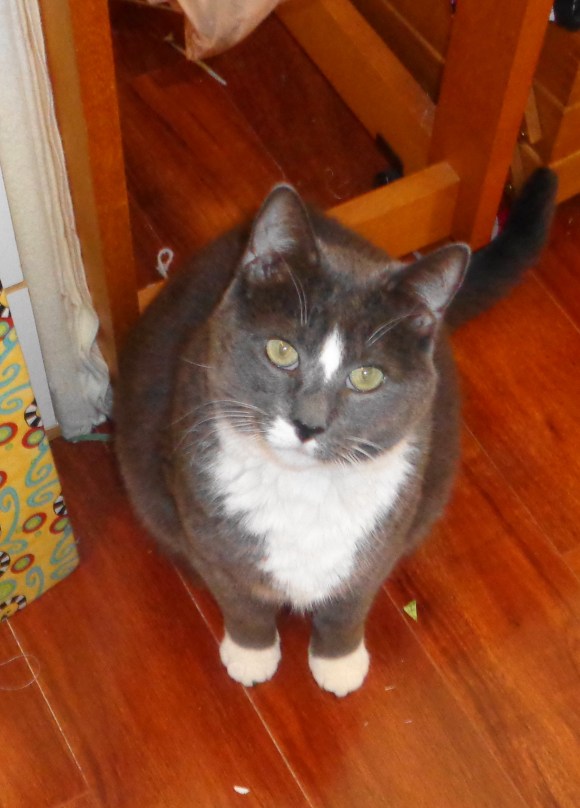
My niece and my daughter took good care of Sam while I was gone, but he did miss me and hasn’t let me out of sight very often since I returned.


Until next week…Quilt Fearlessly!


Love and Stitches,

Sherri and Sam

DSC00763

Categories
Uncategorized

angry face


I rarely write blogs that are not “quilty.”  I like showing pictures about the quilts I’m creating. I like to talk about my quilts and my techniques and new gadgets that I find.  I like to espouse about my wonderful quilting friends and how much they mean to me and how much I learn from them.  I’ve spend half a year encouraging everyone to Quilt Fearlessly. 

However, at this date, I find myself befuddled by the quilting world. 

I was in the field of education for many years, and let me honestly tell you that while that field is full of wonderful individuals that truly love children and want them to learn, it is controlled by politics and politicians who have never sat behind a school desk.  These policies, politics, and in many cases parents, caused me to flee that field long before I was ready to. 

I want to think my hobby and passion – quilting – is immune to these same overtures.  And up until the last couple of years, it has been.  We are living in some unkind and nasty times, my friends.  The world and the quilt studio have become a hostile place.  I’ve always thought of quilters as the types of individuals who live above the fray.  They are the ones that, no matter what is whirling about around them, they live with the serenity if they can just get back to the sewing machine, fabric will make everything better.   Sadly, this has changed in the last couple of years. 

Politics should play no place in the quilting world.  We should uphold each other’s craft, art, and abilities.  We should honor each other’s work and respect it.  Quilts are wide open to a range of talent and interpretation.  None of them are wrong.  The quilt itself speaks to the individual quilter and we should honor that communication even if we don’t understand it or would have made the quilt differently.  The fact that one quilter is a conservative and another a liberal should have absolutely no play in our quilting world.  Our job is to honor and respect each other’s talent, not obliterate each other on social media if we disagree in the ballot box. 

However, in the last couple of months these political disagreements have spilled over onto quilt-related social media.  I would like to make two statements about this:

  1. Stop it.
  2. Be kind. Always be kind.

The last person a quilter should expect to be mistreated by is another quilter. 

To add to this, another well-known quilter was bullied by another well-known quilter about a design.  You may have read that blog.  

And I found something that I sent in an email (yes, an email) show up on Facebook.  The sender of said email asked my opinion in confidence and told me that my opinion would be confidential.  This week I found my opinion on Facebook and the recipient of that opinion was not happy with me. 

Seriously.  

In response to that, I can honestly say, if asked, I would have told the recipient the same thing I said in my email, but wasn’t directly asked. And to the sender of the email, I am surprised.  I thought confidential was confidential. 

People…quilters…get a grip.

 Thumper2

Remember that movie Bambi?  Remember the rabbit, Thumper?  Remember what Thumper’s mother told him?

 If you can’t say something nice, don’t say nothin’ at all. 

If you disagree politically, big deal.  I’m afraid with 24-hour news cycles, the talking heads have not only taken over our televisions, but have also wormed their way into our psyche so that everything we think about must take political overtones.  Let me let you in on a little secret…what goes on in Washington has nothing to do with what you’re doing in the quilt world. 

If you disagree with another quilter on design, keep it off social media.  No one wants to know it.  Keep it between the two of you and work it out.  In the above circumstance, one quilter took the high road and didn’t mention it at all, and the other harped on it for weeks.  

And if something is told to you in confidence, HIPPA laws apply.  Don’t share it, even if it’s anonymously.  Keep it to yourself. 

Lesson learned this week – I’m not putting my opinion in writing ever again.  Not unless I know you really well. 

Let me remind you that there will be no blog next week, as I’ll be on vacation.  The blog will resume on the weekend of June 8.  Until then …. Be kind to each other and Quilt Fearlessly.


Love and Stitches,


Sherri and Sam

dsc00699

Categories
Uncategorized

Fearlessly Updating

An update on the project that started the Year of Quilting Fearlessly…


I don’t know whether I’ve had an epiphany or have just come to the conclusion I have to let go of some projects because I’ve grown to dislike them because I never should have started them to begin with, but I’m giving myself permission to let a few projects fall by the wayside, sell them, or just plain give them away.  The conversations I had with quilters when I was at The Applique Society’s annual meeting keep running through my head.  These were artists who have quilted longer than I have and knew more about quilting and quilts than I ever imagined learning.


So, I’m pruning.  Big time.  I’m keeping the projects that challenge me in a good way.  These are the ones that speak to me, touch my heart, and inspire the creative instinct in me.  However, the ones I find myself putting off working on or probably never really enjoyed to begin with are the ones that are now on the back burner.  Lucy Boston, I think I have found you a new home.  Snowmen?  I will probably pick you back up at some point, but for right now a storage bin is your new home.


But Santa’s Load Dock?  While infinitely challenging, I do love this quilt.  I am discovering that the quilts I now enjoy making are the ones that challenge me every time I sit down and sew or stand at my long arm.  Santa’s Loading Dock does this every single day.  I am the one that must really figure out what technique to use in order to get the desired effect.  It’s not spelled out in the directions (actually, very little is spelled out in the directions…).  I have to decide if I am machine appliqueing, needle turning, or using freezer paper for the applique.  In so many ways, this is really becoming “my” quilt.


Remember the struggle I had with that tree?  The tree that had over 40 pieces?  Lisa and I had some time together before I left for Pinehurst and she taught me a new technique with Inktense Pencils.  This is her tree:

DSC00799

She invited me over on a Sunday afternoon and walked me through the steps, giving generously of her time, talent, and materials.  She had traced the tree out on some Michael Miller fabric for me.  She prefers the Michael Miller fabrics for this process rather than Kona or Moda because the Michael Miller fabric has a firmer weave.  The tree was traced with a Micron Pen.  Then, using nature as the guide, we began to color in the tree with the Inktense Pencils.  Evergreens branches are darker the closer the branch is to the trunk and they grow lighter as the grow away from the trunk.  We used to colors of green to get that effect.  Then we blended the colors together with Liquidtex fabric medium, that was thinned with a few drops of water and then heat-set it with an iron.  This Liquidtex has a slight shimmer to it to mimic the idea of frost and snow.

DSC00800

DSC00801

DSC00803

This is my “practice” tree.


After I returned last weekend, I worked on my “real” tree.  I decided I wanted it a little darker than my practice tree so that it could contrast nicely against the white snow and dark blue background of my window.   Compare this tree…

DSC00846


To the tree I initially made with the 43 separate pieces.

DSC00791

The new one looks so much better.  Despite being a pain to figure out, this quilt does lend itself to many techniques.  And in order to figure out which one is best, you have to pace yourself through different ones.  It also allows you to try new techniques.  This trial and error takes time, but this is a quilt of a lifetime.  You don’t want to rush it and you want it to look beautiful.


And this is what it looks like on the background.

DSC00849

I need to start Rudolph and the candle this weekend and then I can put on the start and window panes.  However, I do need to still work on a couple of Farmer’s Wife blocks and the block for the Quilt Club’s Mystery Quilt.


There is a wedding and dance recital this weekend…not quite sure how productive these next two days are going to be!


Quilt Fearlessly my friends!


Love and Stitches,

Sherri and Sam

DSC00848

Categories
Uncategorized

A Mother’s Influence


This is Mother’s Day Weekend.

And that being the case, I would like to take a few lines to not only wish my mother a very Happy Mother’s Day and thanks for putting up with me for all these years, but also explain what creative influence she’s had on my life.

mom and me (1)

Mom and Me

First of all, you must know that I was raised in a traditional “Southern” household.  Mom and Dad were high school sweethearts and before Dad’s death in 2005 they were heading towards their 50th anniversary.  Mom worked various jobs and owned a couple of businesses before her “retirement” from the workforce. You will notice I put the word retirement in quotes because she technically is still working.  This is where her creative influence comes in.

Besides teaching me that it was wrong to wear white after Labor Day, you’re never more than five minutes late for curfew, and you don’t call a boy before you’re engaged to said boy, Mom was always creating.  She is extremely artistic.  She has painted.  She sews (yes, even a quilt or two), and could have had a second career as an interior decorator.  If you ever have a chance to visit her condo, do so.  It looks like something out of the magazine Southern LivingLet me point out right now that this gene has totally skipped me. 

However, the one creative process that she is known for is her stained glass work.  My mother is a stained glass artist and still teaches two or three times a week at her local community college.  We’re alike in two areas:  First of all we both teach, and second, we are both afraid that if we don’t teach, the art we are passionate about will die with our generation.  The process of quilting and stained glass work are very much alike.  I’ve taken classes from her and was delightfully surprised at how closely the process between the two are related.  So how has Mom’s creative process influenced me?  First, she’s always been doggedly determined to return to it.  There have been a couple of times she’s had to take a sabbatical from her classes.  She’s returned to them as soon as she was able.  The classes allow her not only an outlet for the art, but also a social network of support that is so vital to any artist.  I keep this in mind anytime I have to leave the quilting field for any reason – even it’s only a week-long vacation.


Second, her color choices are terrific.  The influence this woman has had over color choices in my quilts is phenomenal.  She’s never been afraid to throw a deep purple next to a lime green and make it sing.  So, when I’m a little hesitant to make a color choice because I’m scared the quilt police will show up, I do it anyway because she’s taught me that at the end of the process, all the colors sing together in the same choir and the harmony is beautiful.


Happy Mother’s Day Mom.  You are awesome!

______________________________________________________________________________

Last weekend I attended The Applique Society’s Annual Meeting. It was in beautiful Pinehurst, North Carolina.  The Pine Needler’s Chapter hosted the event and the ladies just outdid themselves.  At this point you may be asking “What is The Applique Society?”  Allow me to explain what this wonderful organization is…

This guild/network/organization is a group of quilters that loves all types of applique and works together to keep this arm of quilting alive and well.  While it is primarily an “electronic” group (we are an on-line presence), there are chapters of us in many states and Canada.  These are groups of quilters who belong to TAS that get together once a month to applique and fellowship.  So, besides the opportunity to have an on-line community that supports each other, there is also the local, physical presence of appliquers.

Founded by Anita Smith, our organization will celebrate our 20th Birthday this August.  I’ve been a member of this group for more years than I will admit and have had the privilege of serving as its President last year and was re-elected this year.  If you would like a glimpse of what we do, please visit our open-forum Facebook page or our website, https://www.theappliquesociety.org/.  Membership is nominal but the benefits are terrific.

Now to the good stuff – pictures of the quilts shown at the meeting!

Quilts made by the Pine Needler’s Chapter and the Sand Hills Quilt Guild.  The quilts with the sunflower and other nature scenes are made by Nanette Zellar who was so generous with her teaching techniques.  Nanette is available to speak at guild meetings, etc., and she is phenomenal.

DSC00831

Words of Wisdom from Nanette

________________________________________________________________-

Last weekend also gave me some “down” time.  In addition to a few hours of contemplating my quilting life, I also had some time with Anita.  Besides being the TAS founder (which automatically puts her on the Awesome People list in my life), she has become a friend who I greatly treasure.  Thursday night, we had time together to discuss her work on Love Entwined (if you don’t know what that is, please go to http://estheraliu.blogspot.com/p/love-entwined-1790-marriage-coverlet-bom.html).

Anita Smith’s Love Entwined

Talking quilts with Anita is a wonderful combination of what I call spiritual quilting.  I have many, many delightful quilting friends whom I love dearly, but only a few of them have that spiritual quilting quality. It’s kind of hard to define, but the nearest I can describe it is that this group of quilters allow the quilt to “talk to them.”   Color choices, techniques…it’s dictated by the quilt, not by the quilter or even the designer.  These quilters don’t rush the process, they “breathe” with the quilt.  At times the quilt will tell you to stop and rest from the process.  At other times, it will strongly dictate color choice.  It speaks to you.


To me, this is a vital part of the creative process of a great quilt.  Not all quilts do this, and when I run into one that does this with me, the emotional ties to that work of art are strong – so strong that I can look at parts of that quilt and remember what I was thinking during that process, what I was worried about in my life, what I was praying for.  It’s those quilts – if they could talk – are the treasures in my life.


On the way home, I reflected on my conversations with Anita and this process.  And I realized that there are fewer and fewer quilts like this in my life and I need more of them.  I’ve got to make some changes.  It may mean fewer group quilts.  It may mean limiting my work with teaching and quilting organizations.  It may mean abandoning (for the time being) some of the quilts I’m working on now.  I’m not sure. I just know that I’ve got to begin to allow the quilts to talk to me again.  In the process of keeping up with deadlines, I’ve stopped listening.  The creative process is now rushed to meet the date of the calendar and not a place in my heart.  Perhaps this is the one thing that the Year of Quilting Fearlessly was meant to teach me.


Lesson learned.


Love and Stitches,


Sherri and Sam

SONY DSC
SONY DSC
Categories
Uncategorized

Some Days I Hate Technology….

I have never been so glad to see Friday this week in a long, long time.


You know how it goes.  When you’re young and carefree (read young adult), you look forward to Friday for lots of reasons:

There are parties.

There are dates.

You can sleep late.  Really late.

Alcohol is generally not an issue when you’re in your young adult years.


However when you reach a more …  mature stage in your life, the weekend means something else:  You don’t have to deal with adulthood for perhaps twenty-four good hours.  At this point the kids are grown and out on their own (hopefully), and you can settle into a few hours of mowing the grass and a good glass of wine or three.


This week… this week for me was a real…witch.

hard drive melt down

To begin with on Monday, for whatever reason – virus, update gone horribly wrong, whatever—the files on my laptop decided to disappear. Gone.  Completely.  Not to be deterred, we have Carbonite that backs my hard drive up, so I figure we’re all good.  I got on line, chatted with a nice person named Cory, and was told that since it was more than 24-hours since the hard drive breakdown occurred, I would have to manually reinstall the files since Carbonite had already back up pretty much a blank hard drive early Monday morning.  In other words, the latest back up had nothing in it.


Seriously?!


So, all this week, it’s been a process of downloading zip files and re-installing.


Those folks out there that know me well remember one very important thing about me at this point:  I have no patience for technology that is slow or doesn’t work.  The biggest hurdle I had to get over with my long arm Loretta was that there was a technological learning curve and I had to take my time to learn it.  I’m the type of consumer that if I pay good money for something, turn it on, and it doesn’t work (or at least is user friendly), I’m on the phone demanding customer service fix it now.  I’m nice about it, but I have no time for dilly-dallying around a piece of equipment that doesn’t do what it says it will do on the box.


I’ve spent hours of my life downloading files this week.  Hours that I will never get back.  On the bright side, I am incredibly thankful that we did have backup, that Quickbooks was backed up on a flash drive, and that the back ups did work when re-installed.  Nothing was lost – nothing but hours of my time at the office and at home


Then my car decided it had to throw itself into the mix.  I drive a GMC Arcadia.  I like it (most days), but on the whole, when I get in the car, put the key in the ignition, I expect it to react accordingly and take me where I have to go.  Let me insert at this point, I do take care of my vehicle.  It gets its oil changed on time.  It has regular maintenance and tune-ups.  And it’s filled up with fuel every Wednesday when I’m running errands.  So Thursday I get in my car to go to work, pull off Emsley and onto Kivette and begin to try to inch the speed up to 45 mph, because that’s the speed limit.


No going.  It won’t get itself out of first gear and now the engine light is on.


Like I said earlier, after the computer and now the car, Friday could not get here fast enough.  I turn around, go back home, and call the DH because as far as cars go?  My blonde hair doesn’t stop at the root.  It goes clear through the brain cells because I know nothing about vehicles.  Long story short, there’s this tiny button on the side of my gear shift.  When you press the button, it puts the car in manual mode.  Either you have to press it again to take it out of this mode or turn the engine off for a while and the computer resets itself.  Evidently, I had pressed the button when I moved the gear shift from “Park” to “Reverse.”  I’ve had this car for nearly two years and have never pressed that button.  This week, of all weeks, I did.  My day was in tatters due to another computer.

I know technology is not inherently evil, but this week it certainly had it out for me.  That said, I got literally nothing done in my quilt studio this week.  I’ve been working on the Halo Medallion, Country Inn, and Farmer’s Wife.  I’m holding off on Santa’s Loading Dock until this week when my group meets again.  I’ve decided I’m not happy with my tree, and Lisa has promised to show me how she did hers.  Fate being what it is, I did find some of the pencils she used to paint her tree at the Heart of the Triad Quilt Show last weekend.  A lesson is in order.


There will be no blog next week due to the fact that The Applique Society’s annual meeting is taking place on Friday.  It’s in Pinehurst  and I’m excited about it.  I’ve had the wonderful opportunity to be President of this phenomenal group this year and I am eagerly looking forward to actually meeting some of the women that I conference call with once a month.  I will also have the opportunity to meet Anita Smith, the lady that organized and “birthed” this organization.  Much fun, laughter, and mayhem (not to mention fabric shopping) will ensue.  I will have pictures and stories on my next blog….just remember ladies, what happens in Pinehurst, stays in Pinehurst…


Still quilting fearlessly as technology allows….


Love and Stitches,


Sherri and Sam

dsc00699